
Chinese calligraphy
“I am grateful that I can indeed feel the untimely fairness of calligraphy. That is so much for me.”
SISU News Center, Office of Communications and Public Affairs
Tel : +86 (21) 3537 2378
Email : news@shisu.edu.cn
Address :550 Dalian Road (W), Shanghai 200083, China
19 November 2015 | By Tu Chenyu | SISU
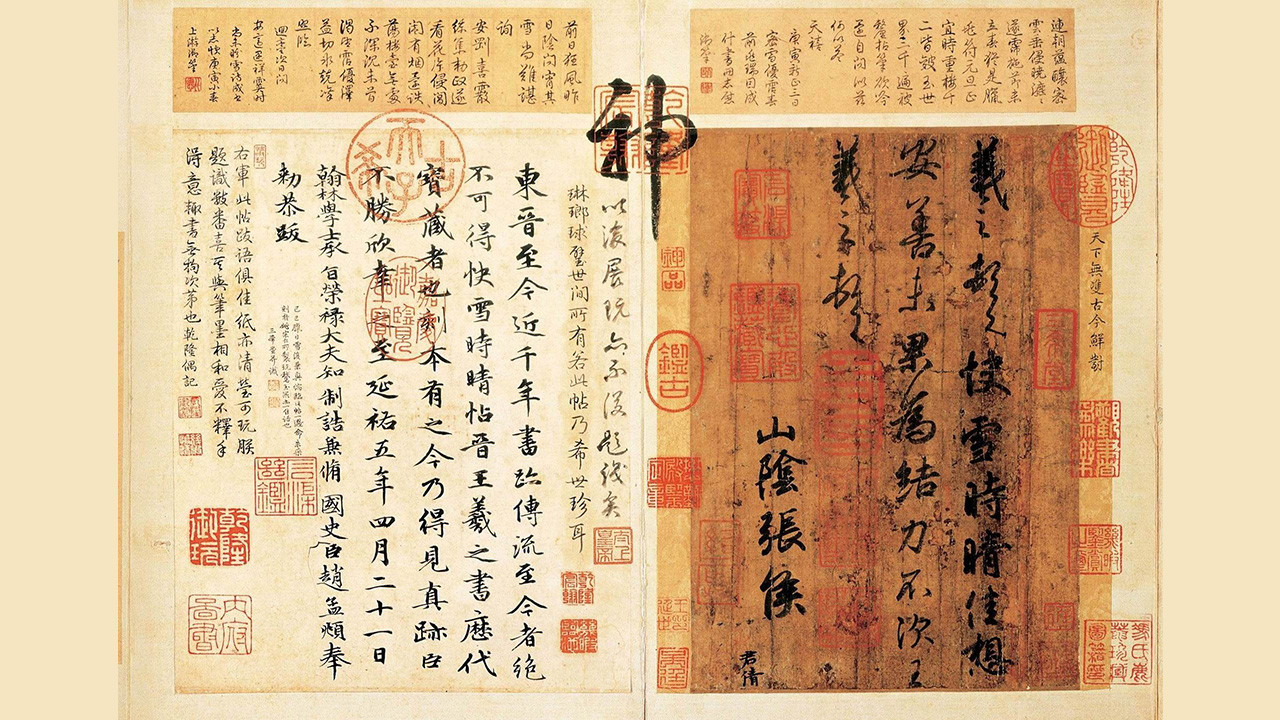
Chinese calligraphy
“I am grateful that I can indeed feel the untimely fairness of calligraphy. That is so much for me.”
|
I |
look up “calligraphy” in the Oxford English Dictionary and read all the examples of how the word is used. Most of them have been written centuries ago. Many refer to the antiquity. One written only a century and a half before declares, “The age of calligraphy is gone.”
It strikes me that my beloved calligraphy is untimely. It appears as untimely as I am. I do not mean that the present age does not care about calligraphy at all. It does care. China now provides more courses on calligraphy than in any other age in its history. Nevertheless, there are few courses in calligraphy.
I took a course on calligraphy at six. My parents asked me to do it. It seemed interesting and I agreed with alacrity. I was indeed taken with the teacher’s penmanship and even envied it at first. However, the minute I began to do the homework that he left, I knew what torture meant. I wrote a horizontal and another one and another one. When I finished 100 horizontals and fancied an end to it, I worked on the 101st one. After horizontals, I wrote verticals, dots, presses, rises, hooks… I thought I would feel better with characters if I could hopefully survive the attack of these horrible strokes, but characters proved a stronger army of nerds. I was bored and indeed so bored as to ponder the meaning of life. I learnt calligraphy in this way for a year and left it behind as soon as the course came to an end. I learnt little. I still did not know the art of handwriting. Calligraphers were all nerds. The course taught me nothing other than that.
A man has changed my view. More precisely, he has changed me. From him, I have learnt what calligraphy means to a Chinese. I should have used the word “feel” rather than “learn,” for he has never lectured on calligraphy. That is a word he has hardly touched upon. What happened was he wrote and I saw him writing. He taught me Chinese in my high school. So I had plenty of time to observe how he wrote each and every character on the blackboard. I enjoyed it. He was a big man and indeed so big as to render delicacy impossible. But he could write with a stick of chalk most delicately held in his hand. Yet it was a firm hold. Every character he wrote consisted of finely-structured strokes that could not be produced either without strength or with that alone. He was modest about his learning, but his writing betrayed it. I could tell he was well-read in the Chinese classics from what he wrote and, more importantly, how he wrote it. He never wrote in a hurry. He did sometimes draw strokes quite fast, but that is because they should be written fast. Those to be written slowly were slowly written. He gave every stroke what its nature required. It seemed less that he wrote the characters than that they came themselves. He never made haste in writing, for as I felt he revered the characters and, religiously, revered the culture.
From this I know what it means to be a Chinese. If an American man sees someone writes well, he says, “Your writing is very neat.” That is all. He never knows how I feel when I behold a true work of calligraphy. In fact, I am not able to describe it in English. If I must, I say it is something of religion. There is a wealth of words in Chinese to describe a work of calligraphy. But they lend themselves least to translation. Even if a foreigner has become well-acquainted with the Chinese language, he is not likely to understand those words more than literally. The feeling remains foreign to a foreigner, as long as he is not “converted” to the culture. Chinese people are among the privileged few who can feel that reverence and that something of religion. For others, Verily I say onto thee. For thou art not born into it. Thou art denied it.
Maybe they are not denied it. It can be instead contributed to and shared by the world. But we are more likely to lose it before the world shares it, for it has become untimely. “Calligraphy” in Greek is καλλιγραϕία, which means literally “fair writing.” But the present age cares little about whether anything is fair, except when fairness is a use. There is always a purpose. The age has graphology but little calligraphy. Many teachers have imposed calligraphy on me because fair writing adds to my performance in an exam. That is one with what I call a course on calligraphy. Time has reduced calligraphy to a use. Now it has nothing to do with history, poetry, or painting. Let alone that something of religion. It is deprived of humanitas. What remains? I do not know.
What I do know is the deprivation means the demise of a tradition. I say a tradition instead of the tradition, for that something of religion is incarnated in many traditions and the tradition hopefully will never pass away. If its heyday is to come again, the tradition has to find its way to the common people. The present society is largely the rational operation of a huge machine that consists of individuals that have their own wills. The machine consults and fashions the wills in order to operate and hence, democracy. But how can we remind the common people of the latent tradition? History has made American populism and it encroaches on our land. Karl Jaspers observes of populism in Man in the Modern Age that the people reject anything beyond their comprehension. It seems to me that most youngsters in China reject the Chinese classics which embody the tradition and are beyond their comprehension. They are ignorant of its latent function. I do not know where the mass-man will go.
But I know where I go. I am delighted to find myself still embracing the tradition. I have fallen in love with calligraphy since high school and into the habit of writing down from my memory lines of classical poetry at leisure. I am grateful that I can indeed feel the untimely fairness of calligraphy. That is so much for me.
The author is a senior student at the School of English Studies at Shanghai International Studies University (SISU).
SISU News Center, Office of Communications and Public Affairs
Tel : +86 (21) 3537 2378
Email : news@shisu.edu.cn
Address :550 Dalian Road (W), Shanghai 200083, China

HONGKOU CAMPUS
550 Dalian Road (W), Shanghai 200083, China
SONGJIANG CAMPUS
1550 Wenxiang Road, Shanghai 201620, China
© Shanghai International Studies University | SISU | 上海外国语大学