
Migrant workers
Serving the migrant workers’ needs for basic public services is a main job of the city government of Shanghai this year. [Gao Erqiang]
SISU News Center, Office of Communications and Public Affairs
Tel : +86 (21) 3537 2378
Email : news@shisu.edu.cn
Address :550 Dalian Road (W), Shanghai 200083, China
24 March 2015 | By Yao Liyan | SISU
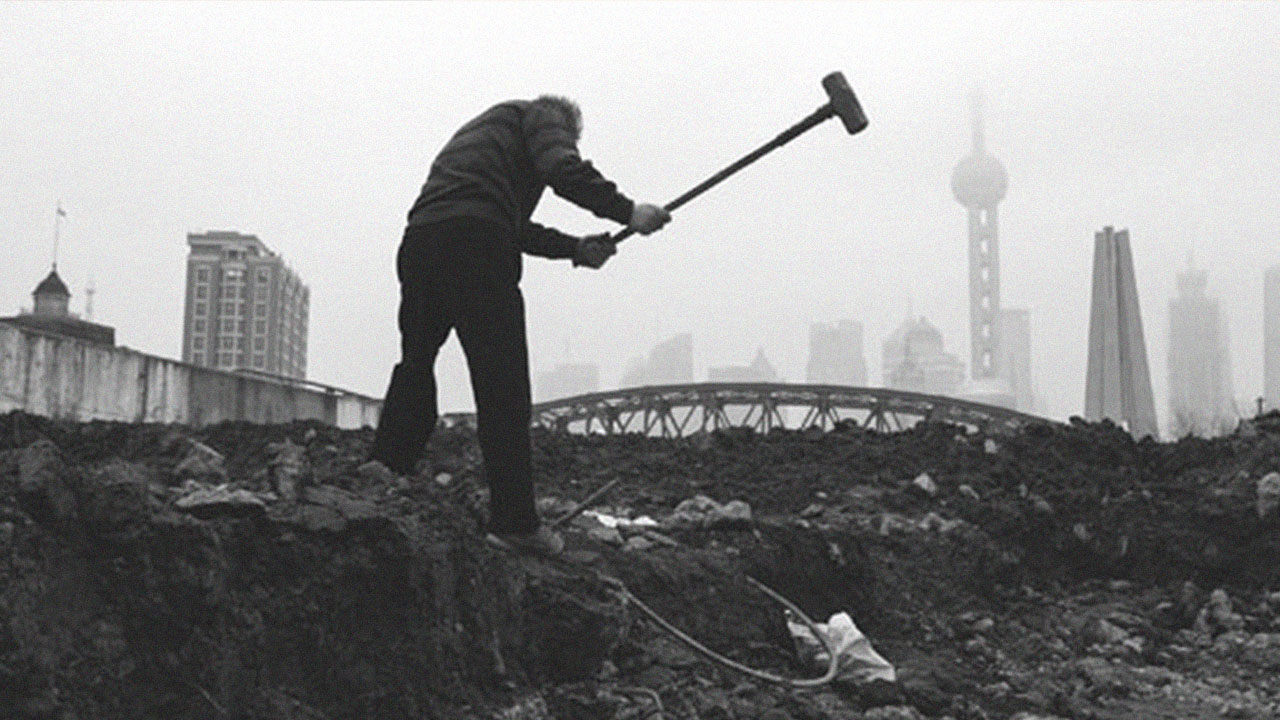
Migrant workers
Serving the migrant workers’ needs for basic public services is a main job of the city government of Shanghai this year. [Gao Erqiang]
Liang Yue, a bartender at the Bund, sat on the bed, his face blank. He had packed up everything into the black canvas suitcase, which lay on the scuffed tile floor.His freshly ironed working suit was nicely folded in the garment bag.
Because of the government campaign on curbing group renting, Liang had to move. He just moved in six days ago from Songjiang district, a suburb that locates two hours by subway from the Bund.
Liang’s apartment was on the mezzanine in a building that was transformed from an old factory. The door was wrapped in thick lavender tarpaulin paper. He had to bend to go through the door.
In the narrow room, the bed occupied more than half the room. A simple bathroom was set up beside the bed, with a bathtub and a toilet. The only electrical equipment in the room was the worn air conditioner that hung above the door. He thought the apartment was fine because there was at least a window to get fresh air and the rent was low. Besides, the room was equipped with a bathroom, so he could take a warm shower.
Liang found the apartment via a real estate agency. According to the rental contract, the apartment was on a three-month lease. He paid quite a lot to finally locate it. 245 Yuan ($40) went to the agency, 700 Yuan ($113) to the landlord, and another 700 Yuan as deposit.
“It is so hard to find a place that is both close to work and cheap,” Liang said.
The apartment may seem nice to low-income migrant workers like Liang, but according to the Procedures of Shanghai Municipality on the Administration of Residential Tenancy, his apartment was another illegal practice of group renting.
Two days ago, Liang got a notice from the authority, demanding him to move out before noon. He had to take a day off.
“How do I find an apartment in such short notice,” Liang complained in a low voice.
Liang was not the only one that got kicked out of his group-renting apartment. At the beginning of May, two fatal accidents in Shanghai have rekindled public concern over the practice of group renting.
Two firefighters died on May 1 while trying to put out a fire in a high-rise apartment in Xuhui district. Ten people lived in the two-bedroom 88-square-meter apartment.
Three days later, a 60-year-old building in Hongkou district collapsed, killing two and injuring three. The neighborhood was known for group renting and most of the residents are migrant workers or street vendors. In one case, a 12-square-meter dwelling was partitioned into three rooms and rented to five people.
Apart from safety concerns, group renting bothers neighbors as well. Many tenants who group rent an apartment in the city are co-workers at businesses such as hair salons and restaurants. When they get off work late at night, they often cook in the kitchen or talk in a loud voice. The silence of the night is broken by the noise.
The government has been making great efforts to crack down on group renting. The Procedures of Shanghai Municipality on the Administration of Residential Tenancy were passed and took effect in 2011, but illegal practices never stopped. People’s Daily reported that one third of the residential areas were plagued with group renting in Shanghai.
The Shanghai government therefore intensified its law enforcement. From this month, Shanghai amended housing regulations to prohibit over two tenants from sharing a single room.
The Shanghai government launched its biggest campaign to ban group renting. Within 13 days, more than 4000 partitioned rooms were torn down and over 11 thousand tenants were forced to move out, Shanghai Morning Post reported.
Despite efforts to discourage property speculation and develop affordable housing, skyrocketing housing prices in China's major cities are pushing new arrivals to share overcrowded living spaces with others or to live in basement apartments, according to China Daily.
China Daily further argued that the tenants themselves are victims as well. A critical player in group renting are those who sublet apartments. They rent rooms en masse, partition them and then sublet them to migrant workers to make money.According to the latest regulation, the penalty on tenants of such practices substantially rises. The fine is now up to 100,000 Yuan ($16,120).
“The ultimate solution still lies in addressing the shortage in low-end housing rental market. Currently, the government provides apartments for lease, but they are accessible only to those who hold a Shanghai hukou (permanent residence permit),” wrote Zhang Yu from Global Times on May 6.
For those who don’t hold a Shanghai hukou, the applicants must have a stable job and their temporary residence permit must be valid for at least two years.
The regulation doesn’t work out for migrant workers. “Migrant workers are highly mobile. They move from small cities to first-tier cities. Probably they don’t even have a job,” saidYao Lingzhen, executive director of the Center for Real Estate Research at Shanghai University of Finance and Economics. Besides, the rent of public housing is only slightly lower than market price, which is still a burden for low-income workers, Yao said.
Liang turned down the apartment arranged by the authority. He decided to settle down in an inn near the Waibaidu Bridge. A single room with air conditioner and cable TV. After negotiating with the owner, they decided on 1200 Yuan for rent. “I’m going to crash here for the time being. I have to work after all,” He said. A room like this was hard to find.
It took 20 minutes to walk from the inn to where he worked. But the 20 minutes separates two worlds,his shabby home and the most glamorous place of the whole city.The Bund is Shanghai’s signature, where stands a forest of skyscrapers and luxury stores. The neon lights of the architectures illuminate the curtain of darkness at night.
At the bar, the transparent French window faces the Bund, with a view of the Oriental Pearl Tower across the Huangpu River, which was enlivened with neon lights and cruising yachts.
The per capita consumption here is at least a hundred Yuan. The table with a view of the Huangpu River costsat least 1000 Yuan.
Liang had just started to work in Shanghai, with a salary of 3000 Yuan per month. “Salary in Shanghai is not high and rent takes at least half of it,” he said. A separate single room costs 1300 Yuan to 1500 Yuan. On renting, one has to pay three-month rent and depositin advance, which reaches 5000 Yuan. For migrant worker like Liang, who has just moved in Shanghai, and spends quite some money on traffic and other legal documents like Temporary Residential Permit, their pockets are tied.
He hoped to live close to his work place. Most of his colleagues live far away to save money, and it took two to three hours to commute by subway between home and the bar.
“I can’t ask my parents for money. Whether the payment is high or not, I need the job,” Liang sometimes asked himself whether he should go back to his hometown - a small village in Shaanxi province in Northwest China, which is less developed than Shanghai. But his bartending skills would not help him find a job back home. More importantly, Shanghai brings him closer to Star Cruises, a Hong Kong cruises company that he longs to get into.
SISU News Center, Office of Communications and Public Affairs
Tel : +86 (21) 3537 2378
Email : news@shisu.edu.cn
Address :550 Dalian Road (W), Shanghai 200083, China

HONGKOU CAMPUS
550 Dalian Road (W), Shanghai 200083, China
SONGJIANG CAMPUS
1550 Wenxiang Road, Shanghai 201620, China
© Shanghai International Studies University | SISU | 上海外国语大学