
Huang Qi at the Great Hall of the People
Huang Qi proposed increasing investments in education for autistic children in the Chinese People’s Political Consultative Conference (CPPCC).
SISU News Center, Office of Communications and Public Affairs
Tel : +86 (21) 3537 2378
Email : news@shisu.edu.cn
Address :550 Dalian Road (W), Shanghai 200083, China
30 March 2021 | By Yang Peihan, Chen Ning, Zhou Jiawen | Copyedited by GU Yiqing
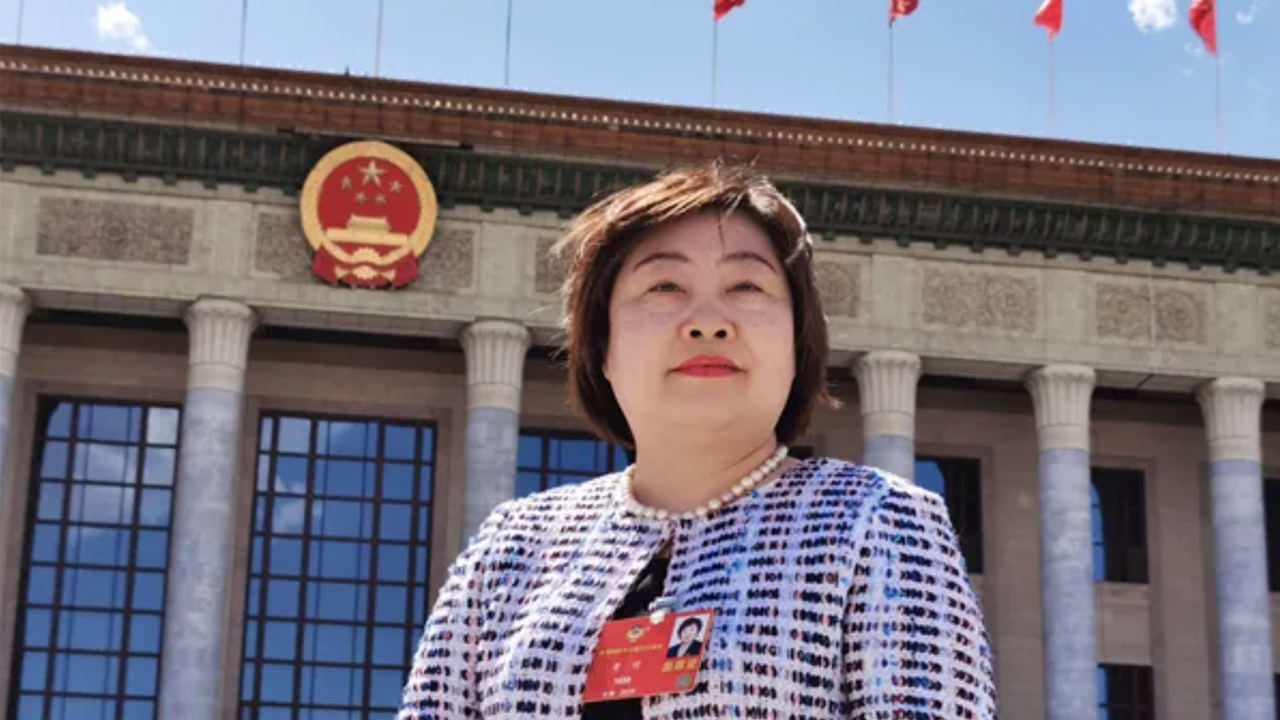
Huang Qi at the Great Hall of the People
Huang Qi proposed increasing investments in education for autistic children in the Chinese People’s Political Consultative Conference (CPPCC).
|
A |
professor from Shanghai International Studies University (SISU) proposed increasing investments in education for autistic children in the Chinese People’s Political Consultative Conference (CPPCC), which was held from March 4, 2021 in Beijing.
“We have special schools for deaf-mute and blind children, and so should we for autistic children!” said Huang Qi, an associate professor from SISU's School of Law.
Autistic children do not fit either ordinary schools or special schools where they usually study with intellectually disabled children.
With the heavy academic work and strict class order, autistic children cannot follow the normal teaching pace. Suffering from poor learning effects and negative self-evaluation, some autistic children have to drop out.
Autistic children can actually learn and behave properly if provided with suitable environment, specific methods and appropriate training. “They just need more time,” said Huang.
A father of an autistic child once told Huang that the school of the United States gave his child twice or more the time for exams. His child has become a movie director.
“He may not be able to complete the test with standard time, but if twice the time is given, he can almost get 100 points,” said the father.
Schools of autism are needed but are scarce in China.
Huang suggested more teacher training, considering that teachers are of top priority for schools specifically for autistic children.
She also appealed for early diagnosis and intervention, as well as long-term treatment. Medical screening from preschool is an example. Children with mild autistic symptoms attend ordinary schools, while those with severe symptoms attend special ones.
“The earlier the treatment, the more effective it is,” said Huang.
Last year, Huang’s proposal of more supportive policies for families and organizations of autistic children received many positive feedbacks.
The China Disabled Persons’ Federation responded by saying that they would fasten the standardized construction of rehabilitation facilities for autistic children, reinforce supervision and carry out professional training.
Some families and organizations of autistic children in Shanghai also came to Huang, which inspired her. Angel Salon, a charity project for autistic children, invited her to a special concert given by autistic children.
Children in Angel Salon learn to sing, dance and play musical instruments, except for Chinese and mathematics. Angel Salon, supported by the Shanghai Charity Foundation, is initiated by Cao Peng, the conductor of the Shanghai Symphony Orchestra, and Cao Xiaoxia, his daughter.
“Compared with the one-size-fits-all education model, music opens the ears and hearts of children, activating their ability to communicate,” said Huang.
Specialized education is just a head start for autistic children’s long march. Huang acknowledged that it is a huge subject for society.
Autism is considered as a neurological and genetic life-long disorder which often results in major difficulties in comprehending verbal information and sensory processing.
It is one of the fastest-growing public health diseases according to the World Health Organization (WTO). As of September 2020, China had a prevalence of autism of 0.7 percent, one in every 143 children, according to a research team at Children’s Hospital of Fudan University.
Huang said, “‘Children of the stars’ may not be able to look into your eyes, but they still want your attention; they may not be able to express themselves appropriately, but they still need your respect.”
SISU News Center, Office of Communications and Public Affairs
Tel : +86 (21) 3537 2378
Email : news@shisu.edu.cn
Address :550 Dalian Road (W), Shanghai 200083, China

HONGKOU CAMPUS
550 Dalian Road (W), Shanghai 200083, China
SONGJIANG CAMPUS
1550 Wenxiang Road, Shanghai 201620, China
© Shanghai International Studies University | SISU | 上海外国语大学