
Jews in Shanghai
Press Contact
SISU News Center, Office of Communications and Public Affairs
Tel : +86 (21) 3537 2378
Email : news@shisu.edu.cn
Address :550 Dalian Road (W), Shanghai 200083, China
Further Reading
JEWS IN SHANGHAI | Rickshaw.org: Artists Soothing Broken Hearts
25 September 2016 | By Liao Guangjun / trans. Huang Xie'an | Copyedited by Gu Yiqing
Editor's Note: During the World War II, more than 30,000 Jews, under attack by the Nazis in Europe, fled to Shanghai, China and 16,000 of them took refugee in this city. Meanwhile, the local Shanghai people were also in an abyss of pain inflicted by the Japanese invasion. Though the time was difficult, gratitude and mutual friendship lived on in the heart of the Jewish and Chinese people. The Shanghai Jewish Refugees Museum and Shanghai International Studies University (SISU) launched a initiative early this year to present those touching stories in Chinese, English, German and Hebrew. This is one of the selected stories in the project to commemorate the history of Jews in Shanghai.
|
S |
hanghai during WWII was just like what La Grande vadrouille presented. It overturned the popular conception of war. In fact, war is not only about misery, anxiety, horror or sadness. In the movie, when Paris was threatened by the flames of war, kids were still able to enjoy puppet shows, and people were still gathering in theatres to appreciate the performance of the Opéra National de Paris.
In the 1930s and 40s, there were also a number of artists in Shanghai, including most notably a group of Jewish artists in Hongkou, who made the people forgetful of the miseries caused by war and gave them hope when they were stricken by dark forces.
One of the Jewish artists was Alfred Wittenberg, the first violinist of State Opera Under den Linden. Alfred fled to Shanghai as a refugee to escape the Holocaust in Europe, and he brought his great art along to China. In the same year, Jewish composer Otto Joachim and his younger brother Walter Joachim also came to Shanghai. They ran a music shop and a small band which often played at the DDS café on the Avenue Joffre (now Huaihai Road). Alfred and the Joachim brothers had come to Shanghai practically penniless. To make a living, they had taught many students in Shanghai who promoted the great music tradition of the world in China. Their students included Prof. Tan Shuzhen who later became deputy president of Shanghai Conservatory of Music, and Situ Zhiwen, a great Chinese cellist.
It is impossible to trace every footstep of the great Jewish artists, but people can still piece up their experience and feel their charm in Shanghai through performance posters, programs, tickets and newspaper clips. For instance, there is a photo of Monica Herenfeld, a great performer, on a poster of her first performance at the Broadway Theatre in Shanghai in 1939. In the photo, she was very beautiful with curly hair, long eyelashes and an elegant smile and looked exactly like Hollywood stars. Lili Flohr and Rose Albach-Gerstel, both singers, also appeared on the posters of operas Dprine und Zufall and Der Orlow. Of course, they had starred more than these two operas. Their beautiful smile and sweet voices must have entertained the troubled hearts of the Jewish refugees and healed their wounds.
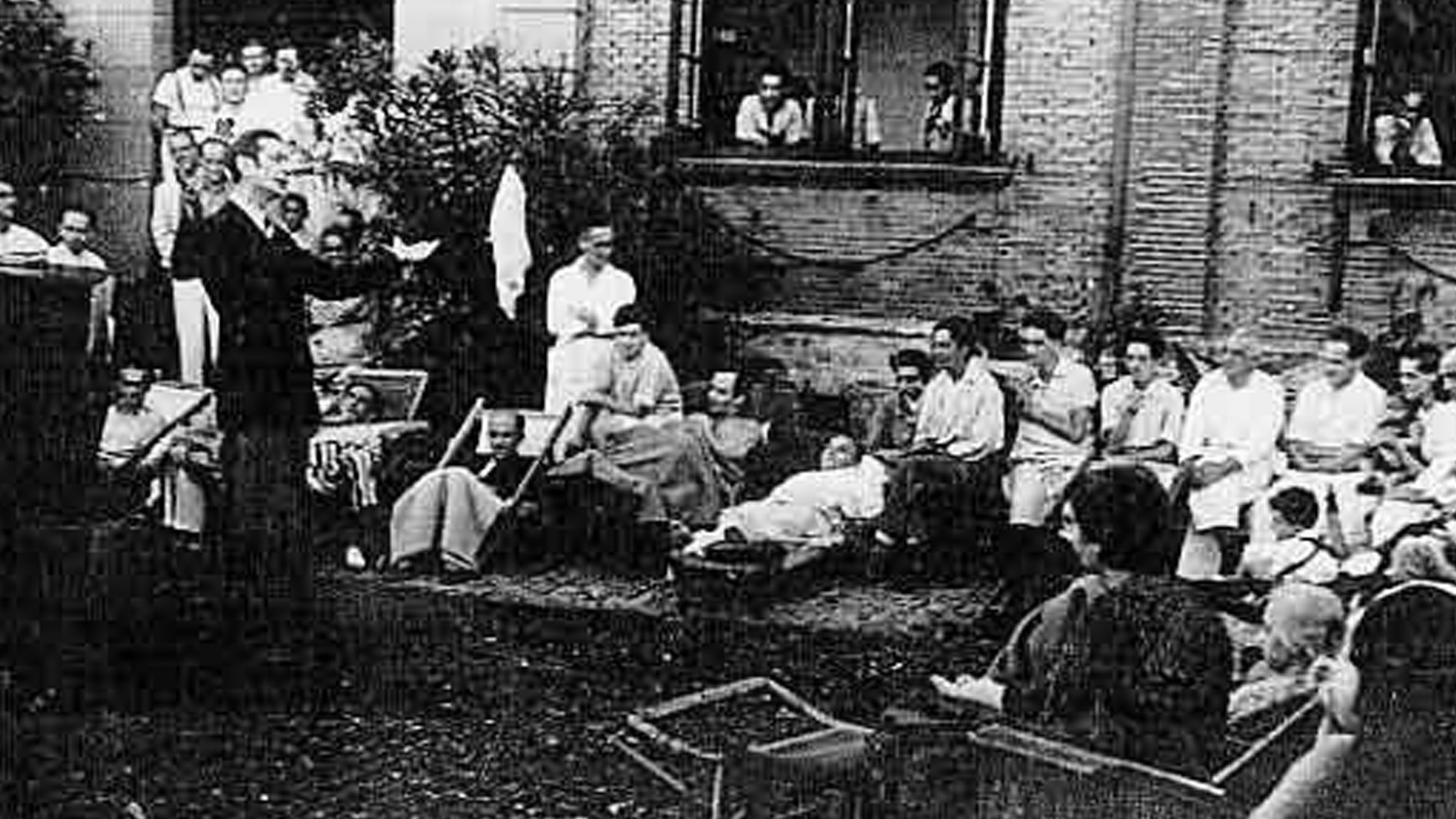
Two comedians were also impressive to the Jewish refugees: Herbert Zernik and Gerhard Gottschalk. They were very popular at that time and their performances were household topics. Gerhard had a comic face and would instantly amuse the audience when he got onto the stage. His stage photos still have this effect. He had a “huge” head over his slim body, and made a “serious” face that solicits laughter. According to a newspaper report, in his performance at the Ward Road Hospital, he pretended to be goal keeper in a football game, wearing a pair of goalie gloves and a high hat. When the opposing players kicked the ball into the goal, he pulled down a curtain in front of the goal line. That was really amusing.
The Jewish refugees in Shanghai had not missed their artistic instincts and they had maintained their cultural identity in Hongkou. They had turned the Tilanqiao area in Hongkou into a prosperous Little Vienna with robust commerce and art. They ran a lot of initiatives like radios, publications, literature societies, sports events, and performances in pubs and roof gardens and at home. They would sing, dance and play wherever possible, and draw big crowds of audience. They would also visit refugee shelters and hospitals, giving the light of hope to the disaster stricken people.
Press Contact
SISU News Center, Office of Communications and Public Affairs
Tel : +86 (21) 3537 2378
Email : news@shisu.edu.cn
Address :550 Dalian Road (W), Shanghai 200083, China
