
Happy Chinese New Year
Thank you for being part of our academic community! Best wishes for the Year of Goat / Sheep to all students, faculty, alumni and friends.
SISU News Center, Office of Communications and Public Affairs
Tel : +86 (21) 3537 2378
Email : news@shisu.edu.cn
Address :550 Dalian Road (W), Shanghai 200083, China
17 February 2015 | By Chen Yue | CCTV.com
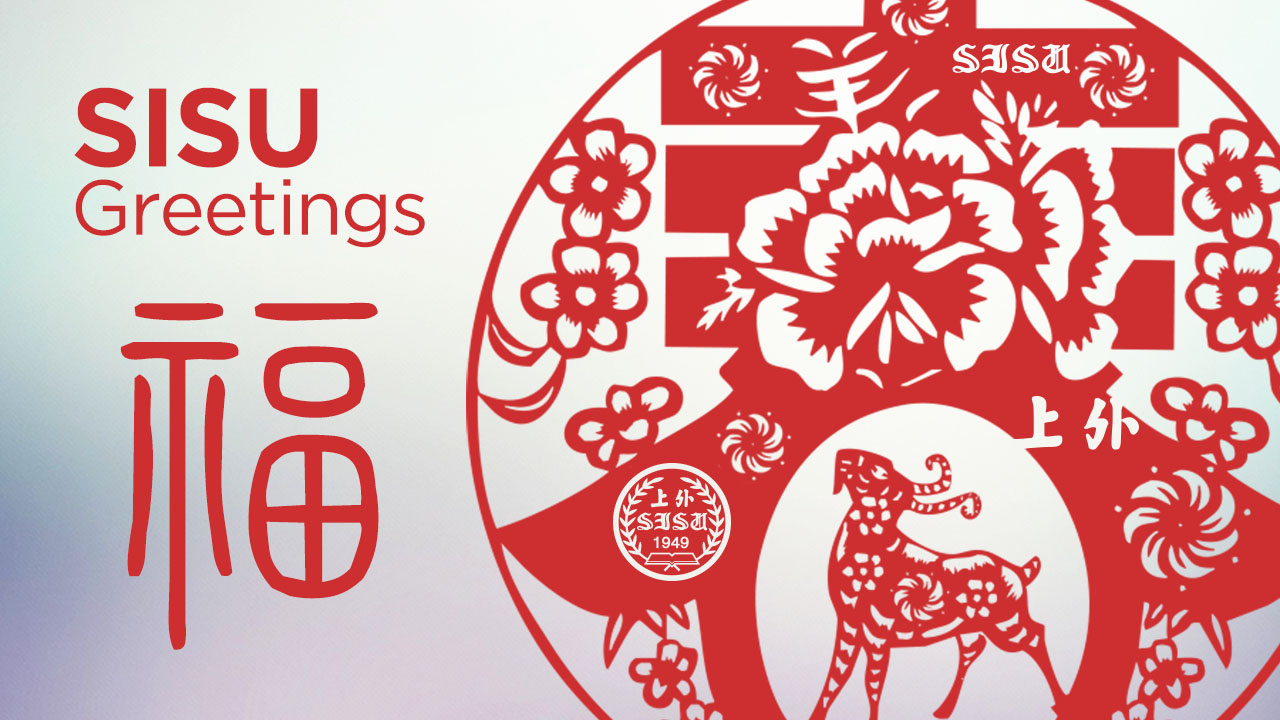
Happy Chinese New Year
Thank you for being part of our academic community! Best wishes for the Year of Goat / Sheep to all students, faculty, alumni and friends.
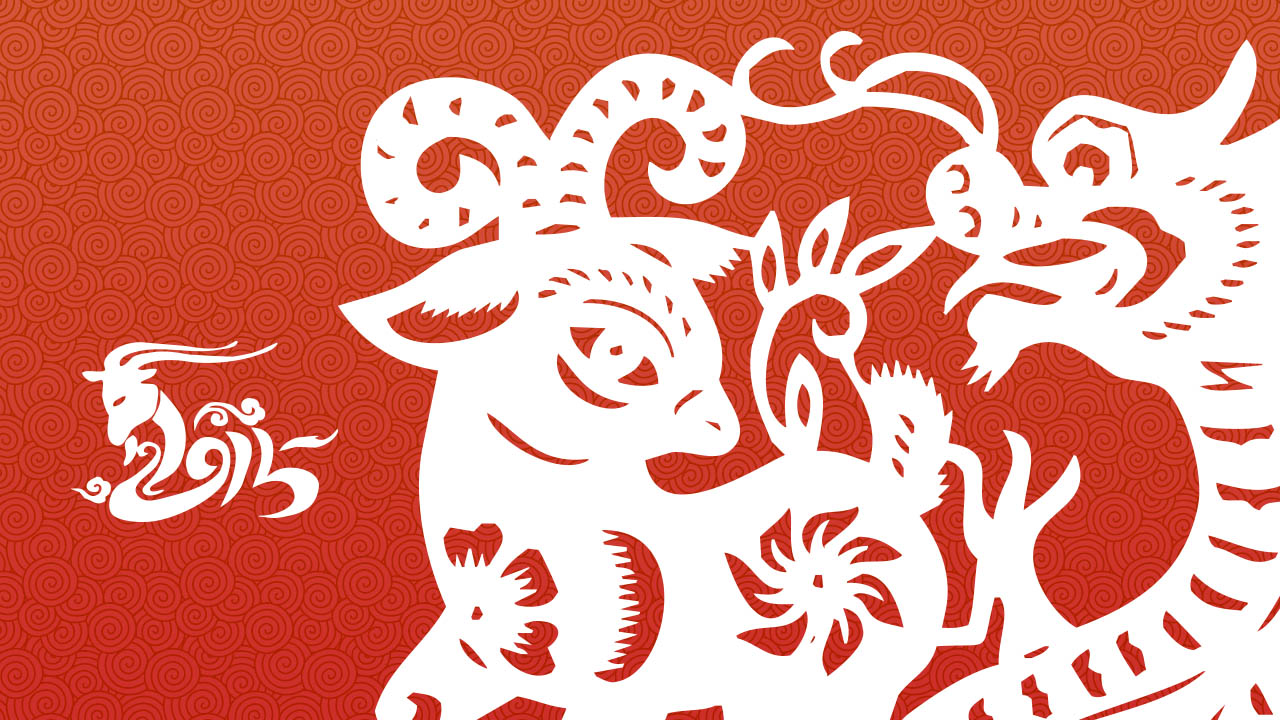
2015: Year of the Goat / Sheep
The Goat / Sheep ( Chinese: 羊; pinyin: yáng) is the eighth sign of the 12-year cycle of animals that appear in the Chinese zodiac.
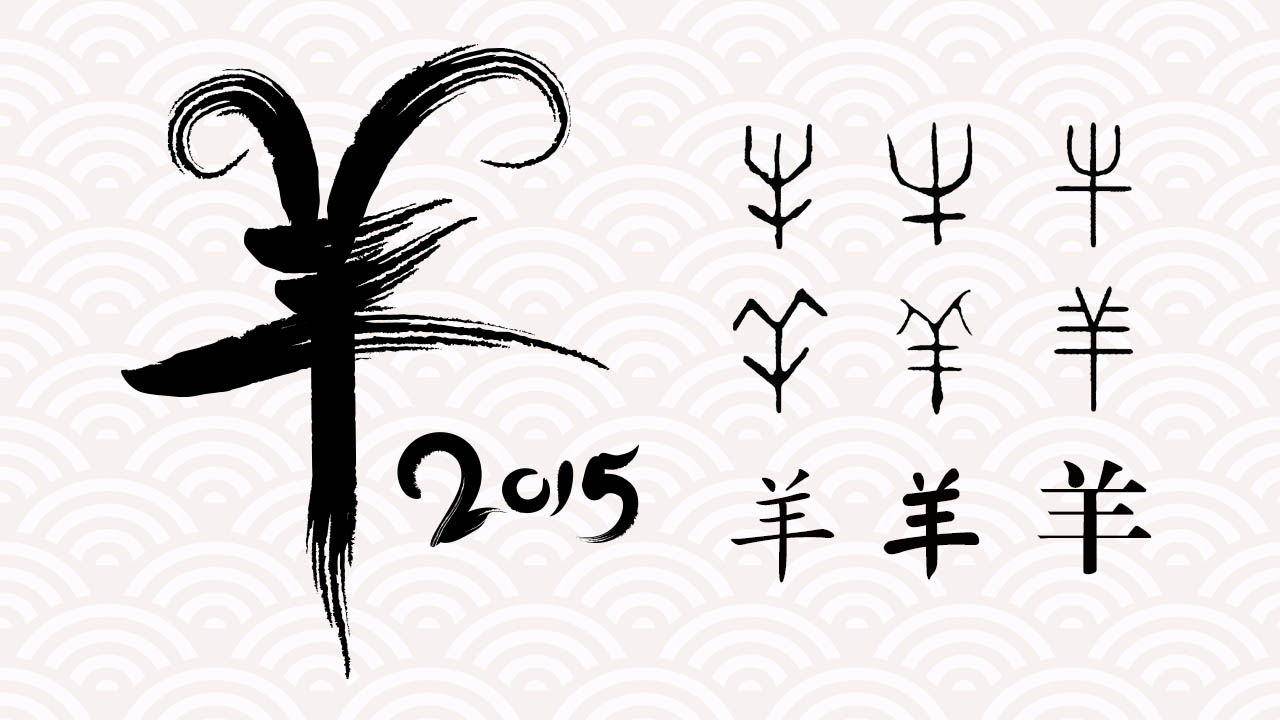
Chinese character: 羊 (Goat / Sheep)
The Goat / Sheep ( Chinese: 羊; pinyin: yáng) is the eighth sign of the 12-year cycle of animals that appear in the Chinese zodiac.
LUNAR NEW YEAR'S EVE – Feb. 18, 2015
Lunar New Year's Eve, the last day of the old year, is one of China's most important traditional holidays. Homes are spotless in and out, doors and windows are decorated with brand new Spring Festival couplets, New Year's pictures, hangings, and images of the Door God, and everyone dresses up in new holiday clothes that are decorated with lucky patterns and auspicious colors.
To the Chinese, New Year's Eve dinner is more than just enjoying a grand feast. On this day, all Chinese all over the world, no matter how far away from home they are or how busy at work, will be home for dinner.
The elaborate dinner is laden with auspicious food. The names of the dishes express the wish for good luck in the coming year. Most dishes are prepared with uncut or whole ingredients to ensure integrity and perfection. The use of knives is considered unlucky as this could sever the family's good fortune.
The sumptuous New Year dinners are prepared with the most delicate culinary artistic skill and good wishes to welcome relatives and friends with a choice of festive treats. Today, a growing number of Chinese choose to have reunion dinners at restaurants or invite cooks home to make dinners for them.
Legend has it that long ago during the age of great floods, there was a vicious monster named Nian, which means year. Whenever the thirtieth day of the last lunar month arrived, this monster would rise up out of the sea, killing people and wrecking havoc in their fields and gardens. The people would bar their doors before dark and sit up all night, coming out the next day to greet their neighbors and congratulate them on surviving. Once on the last night of the last month, Nian suddenly burst into a small village, devouring almost all the people who lived there. Only two families emerged unscathed. The first, a newlywed couple, avoided harm because their celebratory red wedding clothes resembled fire to the monster, so it did not dare to approach them. The other family was unharmed because their children were playing outside setting off noisy firecrackers, and the noise scared the monster away. Ever since, people have worn red clothes, set off firecrackers, and put up red decorations on New Year's Eve to keep the vicious monster Nian away. Later, according to the legend, the Emperor Star deity struck Nian down with a flaming orb and bound him to a stone column. Only then was there peace in the world. Ever since, people stay up all night and burn incense on New Year's Eve, entreating the Emperor Star to descend to earth and protect them.
Every year on New Year's Eve, people paste up images of the Door God on their doors. The Door God, or guardian of the threshold, is a very old deity. In its earliest incarnation, it was embodied in the door itself. The Door God was first portrayed in human form during the Han Dynasty, first as the warrior Cheng Qing, and later as Jing Ke. The door gods of the Northern and Southern Dynasties were named Shen Tu and Yu Lei. During the Tang Dynasty, two great generals named Qin Shubao and Yuchi Jingde were in charge of protecting the officials of the imperial palace. Emperor Tang Taizong (Li Shimin) felt that the generals were working too hard, so he ordered their portraits to be painted and hung beside the palace door to assist them. The two generals thus became associated with the ancient guardians of the threshold, and have been known as door gods ever since. During the Five Dynasties Period, Zhong Kui became the new door god. The Song Dynasty saw the further development of existing guardians and protectors. In addition to door gods, images of the gods of Blessings, Prosperity, and Longevity, as well as the Ten Thousand Deities and the Three-Treasures Buddha, are often hung in living rooms and bedrooms. These guardian deities were thought to protect the household from evil influences and repel demons.
New Year pictures, as their name implies, are made especially to celebrate the Lunar New Year holiday. With the coming of Spring Festival, these pictures appear in households throughout the nation, their bold outlines and vibrant colors adding to the excitement of the holiday season. New Year's pictures are an ancient Chinese folk art, reflecting the simple and thrifty customs and beliefs of the common people, and embodying their hopes for the future.
New Year pictures, like Spring Festival couplets, trace their origins to China's ancient door gods. After a certain point, however, these pictures were no longer limited to depicting the various protective deities, and became increasingly rich and colorful. Among the common subjects of New Year pictures are "A Surplus Every Year," "Peace Year After Year," "Blessings from Heaven," "An Abundance of Grain," "Flourishing Livestock," and "Spring Comes with Good Fortune."
Papercuts made from lucky red paper are often pasted in windows and on doors to celebrate Spring Festival. Papercutting is an extremely popular Chinese folk art. Papercuts usually draw their subject matter from legend, opera, and the twelve animals of the Chinese zodiac. Bold and expressive, they depict a range of lucky themes and beautiful dreams, adding color and verve to the celebratory spirit of Spring Festival.
The character "福" fu means happiness and good fortune. It is as often used as a decoration during Spring Festival, expressing the hope for good fortune and a bright future in the coming year. In order to emphasize the significance of this character, it is often pasted on the door upside down. This is meant to cause visitors to remark, "Your fu is upside down," which is an exact homonym for the auspicious phrase, "good fortune has arrived."
In addition to door gods, Spring Festival couplets, New Year pictures, and papercuts, many families also paste up special decorations known as menjian on Lunar New Year's Eve for good luck. Made out of red or colored paper, these decorations consist of papercuts plus auspicious sayings, with a fringed bottom. Today, instead of the traditional menjian, many people put up "Chinese knots," a type of decoration made out of red cord tied into lucky designs.
Making sacrifices to the ancestors is one of the most important folk customs of Spring Festival. Traditionally, households prepared for New Year's Eve by bringing their family's genealogical records, ancestral portraits, and memorial tablets to the ancestral hall, where the altar was prepared with incense and offerings. In some regions, offerings were prepared for the deities of Heaven and Earth as well as for the ancestors. In other areas, obeisance was made to the Jade Emperor (the highest deity in the folk pantheon), and the Queen Mother of the West (wife of the Jade Emperor). The offerings, known as "offerings to Heaven and Earth," consisted of mutton, five types of cooked dishes, five colors of snacks, five bowls of rice, two date cakes, and a large steamed wheat-flour bun. The rite was conducted by the head of the household. After burning three bundles of incense and bowing to the ancestors, prayers were offered for a fruitful harvest in the coming year. Finally, paper images of money were burned, the smoke carrying the household's prayers and salutations to Heaven. These Spring Festival rituals were a way of wishing the ancestors and deities a Happy New Year.
It was considered imperative to honor the ancestors during Spring Festival, both to remember previous generations and to ensure the continuation of the family line. However, regional differences produced widely differing traditions. In some places, the ancestors were honored before the New Year's Eve feast, while in others the ceremony was conducted at midnight on New Year's Eve. In yet other places offerings were made to the ancestors on New Year's morning, right before opening the door of the family courtyard. In Taiwan, the year's final offering to the ancestors was made in the afternoon of New Year's Day. In some regions, offerings were made to the ancestors at home on New Year's Day, after which the household would travel to the ancestral temple for further ceremonies. In some places, it was customary to conduct the ceremony at the ancestral graveyard, burning incense, making offerings, and bowing to the ancestors. Today, people usually pay their annual respects at the graves of their departed loved ones.
On New Year's Eve, the house is brightly lit as the whole family stays up all night to see out the old year and see in the new. People do more than just sit around as they wait for the arrival of the new year. There is plenty to eat and drink, including wine, cooked dishes, New Year's cake, boiled dumplings, fruit, and assorted snacks, and all kinds of games are played. Since it's nighttime, most of the games are played indoors. Popular games include Go, Chinese chess, card games, and mahjong. Before it gets dark, children ride bamboo horses, spin tops, and play games like "Eagle Catches Chicken" and "Blind Man's Bluff". As midnight approaches, the parents prepare the family altar. They then light incense and make offerings to the ancestors and auspicious deities, bringing the New Year's festivities to their peak. After the ceremony is over, everyone exchanges New Year's greetings and eats boiled dumplings. It is also traditional to set off fireworks and firecrackers on New Year's Eve. As it gets closer and closer to midnight, nonstop explosions fills the air and the sky is filled with a sparkling display.
Since the 1980s, it has become extremely popular to watch the annual "Spring Festival Variety Show" on television on New Year's Eve.
LUNAR NEW YEAR'S DAY – Feb. 19, 2015
Lunar New Year's Day is the first day of the year, according to the traditional lunar calendar. With the adoption of the solar calendar, New Year's Day came to refer to the first day of the solar year. In order to distinguish the two, Lunar New Year's Day is sometimes referred to as Spring Festival. The Lunar New Year is China's most important traditional holiday. However, this holiday is not just one day; rather it encompasses an extended period of time, often lasting until the fifteenth day of the first lunar month.
Legend has it that long ago there was a king named Zu Yi who found it difficult to predict seasonal weather changes and the movement of wind and clouds. He ordered his minister Ah Heng to build an altar and make sacrifices to the deities seeking their assistance. But the deities did not reply. As it happened, a young man named Wan Nian had just invented the sundial and a four-level water clock, which enabled him to accurately predict weather conditions according to the changing seasons. Wan Nian sought out the king and presented him with his inventions. The king was delighted with this development, and ordered Ah Heng to use the new inventions to create a calendar. But when Ah Heng climbed to the top of the Temple of the Sun and Moon, he saw the following poem written by Wan Nian inscribed on the wall:
The sun rises and sets three-hundred and sixty times, circling the horizon to return to its beginning.
Plants wither and flourish over four seasons; twelve moons make up one year's cycle.
When Ah Heng saw this poem, he realized that Wan Nian had already invented the calendar. Fearing that he would fall out of favor if the king learned of this accomplishment, Ah Heng sent an assassin to kill the young inventor. However, his plot was not successful. The king richly rewarded Wan Nian, who exclaimed, "Now the old year has ended and the new year begins; will the king give this auspicious day a name?" Zu Yi replied, "Let it be called Spring Festival."
In northern China, the first meal of the New Year is boiled jiaozi (stuffed dumplings). In the south, it is niangao (New Year's cake). In Chinese, niangao is a homonym of the phrase "higher every year," signifying the wish for steadily increasing prosperity.
New Year's cake is made with glutinous rice and short grain rice, plus sweet osmanthus sugar, lard, nuts, and candied fruit added according to taste. New Year's cake can be steamed, boiled, deep-fried, or stir-fried. Its sweet taste and chewy texture make it a favorite holiday treat.
After the first New Year's Day meal is eaten, offerings are made to the ancestors in the family ancestral hall. After consulting the almanac to determine the luckiest route, the family sets out on a procession, bearing lanterns and offerings to the auspicious deities, burning incense, and setting off firecrackers. When they reach the temple, they burn more incense, pay their respect to the deities, and entreat them for good fortune in the coming year.
Another Spring Festival tradition is gathering sesame stalks into bundles. The height and straightness of the bundle symbolizes high achievements in the coming year.
No Spring Festival would be complete without the sound of firecrackers. Firecrackers and fireworks are traditionally set off on New Year's Eve and on Dragon Boat Festival, the fifth day of the New Year. In addition, it is also customary in many regions to set off fireworks early in the morning of New Year's Day, when the front door is first opened for the day. This tradition, known as "front door firecrackers," is meant to welcome the first day of the new year.
Firecrackers have a very long history in China. The first firecrackers consisted of segments of bamboo that were set on fire, causing them to explode with a loud noise. They were used to scare away ghosts and banish evil. Firecrackers have traditionally been associated with the supernatural. In addition to frightening ghosts, they were also used to see out the old year and welcome in the new. Eventually, they came to symbolize a prayer for peace. There are many different kinds of firecrackers and fireworks, including noisemakers, sparklers, and colorful pyrotechnics. Today, fireworks are used primarily to heighten the festive holiday spirit. However, because of the injuries and environmental pollution caused by fireworks, a number of cities have banned or limited their use, replacing them with other holiday activities.
Another distinctive Spring Festival activity is the custom of making New Year's calls to friends and family in the first days of the New Year. If New Year's offerings to the ancestors represent remembrance of the departed, New Year's calls represent appreciation of the living. Making the rounds to offer New Year's greetings expresses affection and strengthens the bonds of friendship and family. In the past, if the head of a household had too many friends and relations to pay them each a personal visit, a servant was delegated to deliver name cards or lucky characters. This custom was widespread among the upper classes. The people receiving callers often gave their elder visitors red envelopes containing lucky New Year's money.
The New Year's customs of the common people were influenced somewhat by those of the upper classes. During the Ming-Qing period, members of the court often paid New Year's calls in groups. This custom is still popular among the common people today.
Today, there are a number of new ways of conveying New Year's greetings. In addition to paying New Year's calls, people send New Year's cards, make phone calls, send electronic greeting cards, or use cell phones to send short text messages.
SISU News Center, Office of Communications and Public Affairs
Tel : +86 (21) 3537 2378
Email : news@shisu.edu.cn
Address :550 Dalian Road (W), Shanghai 200083, China

HONGKOU CAMPUS
550 Dalian Road (W), Shanghai 200083, China
SONGJIANG CAMPUS
1550 Wenxiang Road, Shanghai 201620, China
© Shanghai International Studies University | SISU | 上海外国语大学