
SISU Library: “The Library of Babel”
I have always imagined that Paradise will be a kind of library. / yo, que me figuraba el Paraíso bajo la especie de una biblioteca. - J. Borges
SISU News Center, Office of Communications and Public Affairs
Tel : +86 (21) 3537 2378
Email : news@shisu.edu.cn
Address :550 Dalian Road (W), Shanghai 200083, China
27 April 2015 | By Dane S. Claussen and Zhou Jiawen | SISU

SISU Library: “The Library of Babel”
I have always imagined that Paradise will be a kind of library. / yo, que me figuraba el Paraíso bajo la especie de una biblioteca. - J. Borges
|
T |
o become a life-long reader takes time, concentration and practice. If the goal is, how do you prepare for the habit of reading all one’s life, it seems much can be said for giving oneself broad choices. One good place to start is with any publicly available reading lists for university courses. Maybe the list is bewildering, maybe you cannot obtain all books on this list. But still, such lists are carefully prepared and most people have not read the books, so the lists are useful and interesting.
Idea of a reading list
Making lists of books students want to read or should read is a typical task for professors. In SISU’s School of English Studies, the reading list is determined by the discussion at the School’s conference and can be later adjusted according to practical circumstances. “Adding Chinese books to the new reading list is one of the best ways to encourage Chinese students’ interest in reading,” the School’s English Studies teacher Xu Libing said.
Classical literature contributes most to the reading list recommended by Feng Xiaoli, based in SISU’s School of Business and Management. Feng said: “Reading classical literature is of great significance to enlarge students’ vocabulary, widen their knowledge, develop their writing and communication skills, and improve their abilities to appreciate art.”
Gao Liping, a teacher in SISU’s Russian language major, is always able to connect Russian writers mentioned in her classes with a reading list of their related works. She said, “Some students in this major will probably choose to pursue degrees in other fields after graduation. I hope they can start to have a broader knowledge base from the first year of college study.”
A reading list made by Zhang Haibin, a teacher in SISU’s School of French and Francophone Studies, has a wide range of books, including specialist titles, novels, the Chinese classics and reference books. He said: “Reading can help expand the knowledge whilst actually increasing the fun. Reading comprehension is a cognitive developmental process, which takes a moment to reflect and get your life in balance.”
Reading lists cannot be copied
Every reading list serves a different purpose. Students in SISU’s School of English Studies are advised to try a wide variety of books including those on dramas, history, philosophy, aesthetics and economy, which are mainly written in English and ranked in order of difficulty.
Students in the minor-language majors, however, cannot read so widely, because much of their time is spent on grammar and vocabulary study for classes. Second-year student Yuan in SISU’s Spanish major said that there is no recommended reading list as it is difficult to read books written in Spanish. Student Lan in the School of Japanese Studies said that teachers recommend books in the School’s reference room because they are donated mostly by Japanese schools and have no borrowing deadline.
Do reading lists work?
More than half of SISU students think that reading lists help to set their reading aims and direction, according to a survey.
The survey also shows that too many choices is the largest problem of a reading list, with over 60 percent of SISU students depending on their own interests to choose books. Student Pei of the School of Education said: “I prefer to read books recommended by my friends rather than refer to a reading list, since we have similar reading preferences.”
What is a good reading list? Nearly 80 percent of SISU students in the survey suggest that a good reading list should involve wide subjects and moderate difficulty.
Reading preferences
Which books will be selected for a supposed reading list for all SISU students? Qian Junni, a teacher in SISU’s School of International Relations and Public Affairs, said she prefers books that can contribute to the understanding of Chinese culture and transnational communication.
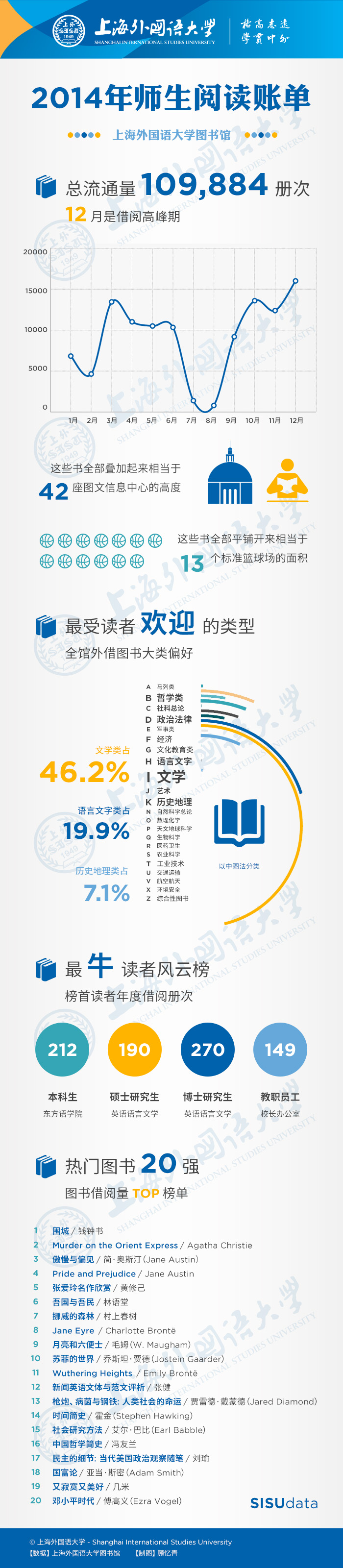
According to the survey, nearly 80 percent of SISU students think literature, whether it is classic or contemporary, is necessary for such a reading list, and just as important, are books on history, philosophy and an encyclopaedia. Pride and Prejudice, David Copperfield, Ordinary World, One Hundred Years of Solitude and a famous Chinese classical novel A Dream of Red Mansions were voted the list’s five most popular books in the survey.
Nearly 80 percent of SISU students hope the number of books on the list is between 20 and 50 with the ratio of written languages – English/Chinese – is 1:2. The remainder are more aware of the content of books.
Have you read today?
A reading list works only when the books on it have been read. Most of SISU’s first-year and third-year students have more than three hours per week for extra-curriculum reading, while most of second-year students can read for only two hours at longest. The majority of SISU’s first-year students can read more than five books on average for each semester; but for students of the second year or third year, the number decreases to two at maximum. Nearly 60 percent of surveyed students are not satisfied with their reading situation and eager to read more.
The largest influence on students’ reading is insufficient time pressed by intensive courses, assignments, club activities and social networking. A student, Zhang, in SISU’s School of International Relations and Public Affairs said: “University life is so busy that I only want to take time off to relax. Obviously, serious reading is not a good way to rest my mind.” A student Wang of SISU’s School of Business and Management said: “There are also some students who do not read just because there is a lack of the atmosphere of reading.”
SISU News Center, Office of Communications and Public Affairs
Tel : +86 (21) 3537 2378
Email : news@shisu.edu.cn
Address :550 Dalian Road (W), Shanghai 200083, China

HONGKOU CAMPUS
550 Dalian Road (W), Shanghai 200083, China
SONGJIANG CAMPUS
1550 Wenxiang Road, Shanghai 201620, China
© Shanghai International Studies University | SISU | 上海外国语大学