
SISU Volunteers at Milan Expo
Expo Milano 2015 is the Universal Exhibition that Milan, Italy, will host from May 1 to October 31, 2015.
SISU News Center, Office of Communications and Public Affairs
Tel : +86 (21) 3537 2378
Email : news@shisu.edu.cn
Address :550 Dalian Road (W), Shanghai 200083, China
02 June 2015 | By Ma Wenxi, Wang Rui and Ma Sang | Photo by Zhang Wei, Zhao Wanting, Bai Yifan and Ma Wenxi
SISU Volunteers at Milan Expo
Expo Milano 2015 is the Universal Exhibition that Milan, Italy, will host from May 1 to October 31, 2015.
SISU Volunteers at Milan Expo
Expo Milano 2015 is the Universal Exhibition that Milan, Italy, will host from May 1 to October 31, 2015.
SISU Volunteers at Milan Expo
Expo Milano 2015 is the Universal Exhibition that Milan, Italy, will host from May 1 to October 31, 2015.
|
W |
ith much fondness, we bid farewell to May and now embrace our second and last month at the Milan Expo. In the past 30 days, I encountered people from diverse cultural backgrounds, and every day has been an adventure with new things to discover, valued moments to remember and friends to share all this with.
Though I have already said this more than 100 times, I must say yet again that it is really a precious opportunity for me to have a totally different life in Italy, a country of energy, fashion and friendliness. Here I was lucky and privileged to have had a bite-size of everything “Italian and international”--the local flavors, dazzling technology, and cultures in dialogue. As a Chinese, I have received the respect from foreigners, and often heard acclamations for China.
At those very moments, I felt a responsibility to behave myself, an innate connection between me and my nation, and a desire to let foreigners get to know a real China. To know more about Milan Expo, please follow me, and my story as a volunteer at Milan Expo will start from the China Pavilion.
My Adventures in China Pavilion
The China Pavilion is much praised for its eye-catching appearance: boulder? walls in deep red, stone lions guarding the giant bobbles of peacock flowers, and a cobbled road guiding the visitors to the Preface Hall of China Pavilion.
There, a spectacular architecture salutes people’s eyes, shaped as a wheat field waving with the wind. This is the place where our 36 Chinese and Italian volunteers serve. Despite the busy schedule and sometimes capricious weather, the first month left me an unforgettable memory of great rejoicing and enjoyment.
My workday starts here: the theater on the second floor. Every day we welcome the visitors with big smiles and the Italian greetings “Buongiorno” or “Buonasera”, and guide them to enjoy the shows in the theater—an animation about Chinese New Year Festival as well as an alive dancing by a group of local performers from the Hani minority in Yunnan province. The dancing show is so captivating that every time when the show finishes, I can hear rounds and rounds of applause and people’s hearty cheers “Multo bello!”, “Bellissimo!” (Italian for beautiful) from outside.
Beside the theater stands a wall with hanging pictures which exhibit Chinese sceneries and food culture. The three “hottest pictures” are the nightscape of Shanghai Lujiazui, pandas in Sichuan province and steamed dumplings. Seeing that there were a lot of visitors discussing Shanghai World Financial Center, my Italian friend Camilla told me that in Italy, many people would call SWFC as “cavatappi”, which was used to open the bottle cap of the beer. “The same for Chinese people!” I replied.
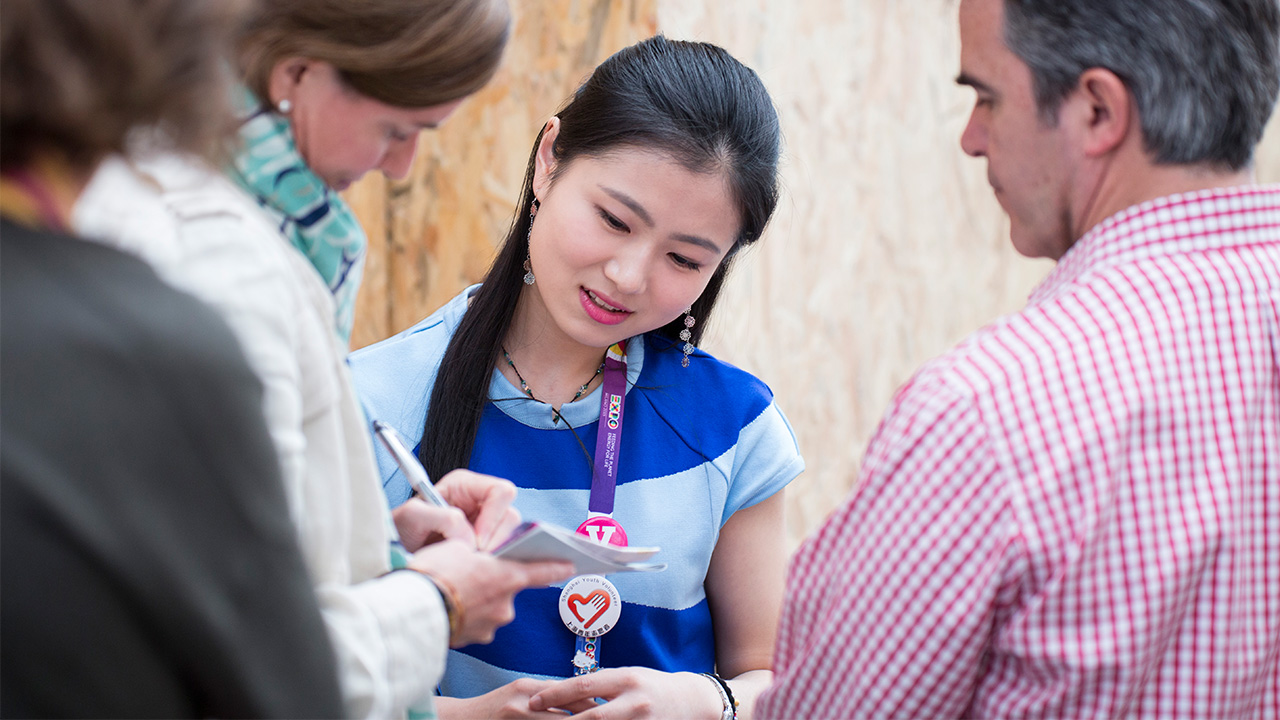
Every visitor has his or her own story, and when people come up to you, greeting you in Chinese with a heavy accent, and then generously sharing their experiences and ideas with you, you will marvel that the world is so small and life is so rich and diverse. For example, Japanese visitors were fanatics of collecting pins. Thus on the most occasions they are the easiest to be recognized, since they will wear all varieties of pins seeking for an opportunity to exchange them.
An aged Italian couple told me that their son married a Chinese girl, and they were now living in Shanghai with two sons. The grandpa presented the pictures of his two grandsons in the cellphone, and I was surprised by their “normal faces”. “They don’t look like their father at all!” the grandpa smiled and said. And what about running into a schoolmate, an Italian young man who studied in Shanghai International Studies University (SISU) a few years ago? He showed me a picture of Hongkou Football Stadium metro station and related his life in Shanghai with very limited Chinese words. Sometimes life will surprise you in the most unexpected way!
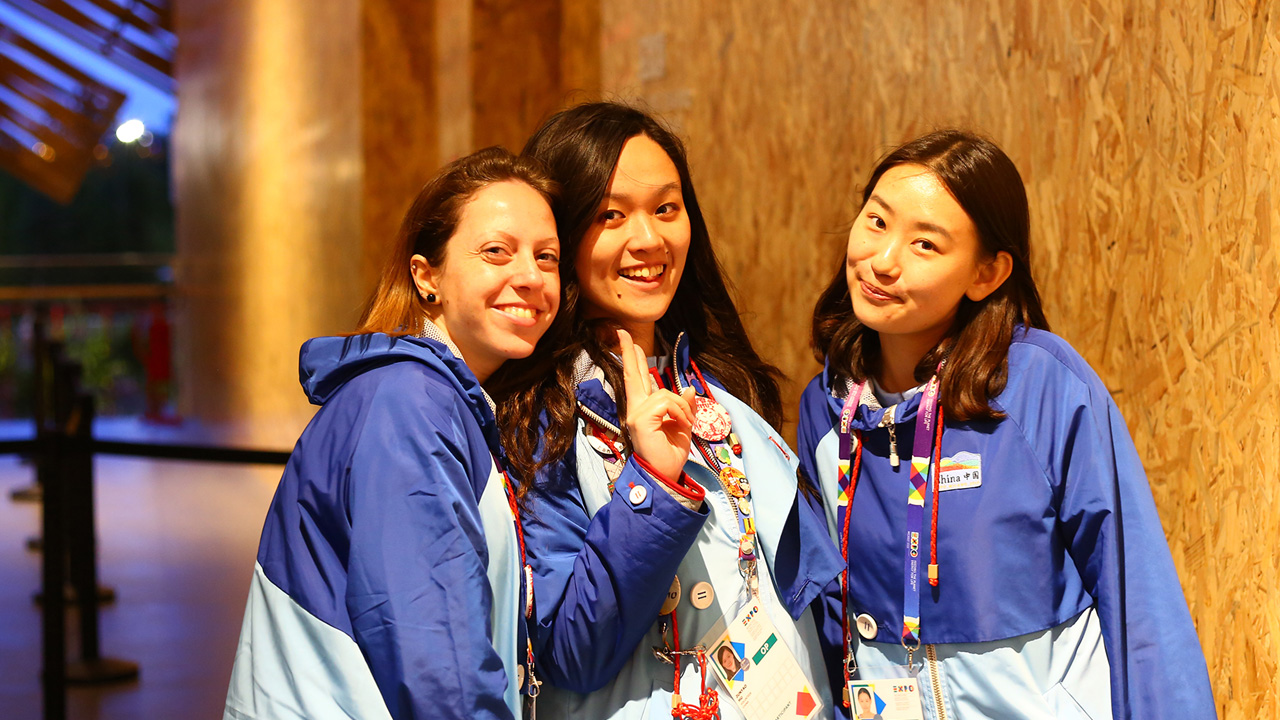
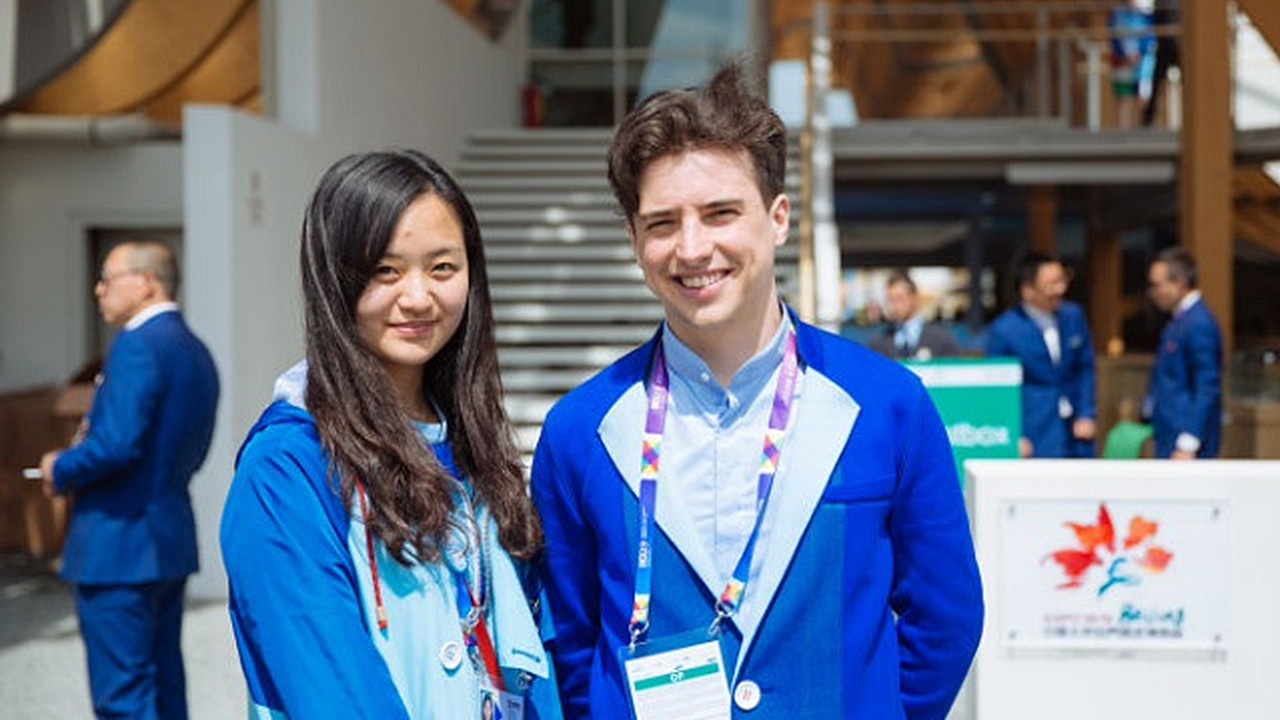
“shi si hai shi si shi?”: Chinese and Italian Volunteers
As I have mentioned, Italians are amiable and energetic. It’s easy to get on well with them, and within a short period we have established tacit connections. As part of the Expo legacy, we taught them our signature Chinese tongue twister: “si shi shi si shi, shi si shi shi si” which means fourteen is fourteen, and forty is forty. Tortured by the transference between “shi” and “si”, they took their sweet revenge by teaching us an Italian tongue twister with a surplus of “r”s.
We are also impressed by the Italian volunteers’ versatility. To speak three or four languages is common, and some even excel at not only English but also a third language, like Chinese. After daily chit chat with the Italian friends, I learned that in their high school, English is a compulsory course. Additionally, Students have to select another language among French, German, etc.
Luca, an Italian volunteer, is very articulate and talkative. On May 31st, at the opening ceremony of Beijing Week, he had a special task to do for the guests who were mostly Chinese—to introduce the exhibitions of tea culture, Silk Road and Anhui tofu. The way he presented and the content he selected really impressed me. “In western countries we eat cheese. When we first contacted tofu, we called it ‘Chinese cheese’—a kind of softy and smooth cheese without milk.” Very attractive opening, don’t you think? Luca said: “Since my audience are Chinese, they will know better than me about the process of making tofu. So this is my way to introduce tofu, in a respect of foreign culture.” From Luca as well as other volunteers, we get a feeling of consideration, creativity and responsibility.
Beyond the China Pavilion
Sure there is more to see. Let’s now go outside of “the waving wheat”, and unlock new levels by touring the other pavilions and discover how China and other countries connect.
The Milan Expo is an international event with more than 150 participating organizations and countries. Other than English, which is the lingua franca, as well as Italian, I found that UK Pavilion provided Chinese translation in their exhibition walls, Slovakia Pavilion had Chinese language selection on their iPads, and Italian staff who served in Japan Pavilion, McDonald’s and other places happened to speak Chinese very well.
The Japan Pavilion presents a similar concept with China, which is “harmony”, but focuses more on details such as the skills of matching the ingredients with seasons and weathers, the preservation of materials’ originality and the arrangement between delicious cuisines and pleasant scenery. The United States Pavilion’s 7 successive animations express an idea of multicultural diversity of eating food and the dissemination of American culture. With a golden turkey staying at the center of the table, eaters change from race to race, and the side dishes also change accordingly, from dumplings to pasta.
A journey to the other pavilions is the fastest and the best way to learn the essence of their cutting-edge technology and innovations. I am still on the way, and try not to forget what “Expo Grandma” Tomiyo Yamada said: “Remember the initial and core meaning of Expo.” For me, the ideas matter the most, instead of fancy equipment or costly technology. The latter are indispensable for the narrators to better present the stories, but what props everything up is the idea, the message, which the current world needs most, and of which we never heard before.
Take Israel Pavilion, they perfectly display Israel culture and its proudest irrigation methods through only movable screens and a 2D video, and successfully present the wisdom of saving the most significant natural resource—water.
As for Switzerland Pavilion, what they all have are four neat rooms filled with cartons. You can take Nest instant coffee in the first room, slices of dried apple in the second one, salt in the third room and plastic cups in the last one, which are used to contain drinking water from the sideward tap. What is even more interesting is that all the items are free to the visitors. You can choose to take only one of each item, or demand as many as you want. Owing to the fixed supply, the water cups and the slices of dried apple have been running out. Through this way, Switzerland tries to teach people an important lesson: resources in the world are limited and irreproducible, thus we need to reexamine our real demands and avoid squandering.
One month has passed; we still have 30 days to go. It is a sweat-bitter journey if you think only of 6-hour-work per day and endless greetings. But it would be 30 precious and rare days if you recall all the crystalline memories in the last month and are prepared to embrace the new unknowns.
Looking ahead, I know I’m going to treasure my days at Milan Expo. Beloved friends, efficient work partners, the Italian volunteers, all the visitors with their different ways to surprise and delight, and every bite I took of the palatable food, and every road I’ve walked along. Many thanks to each and every one who has joined me in Milan!
SISU News Center, Office of Communications and Public Affairs
Tel : +86 (21) 3537 2378
Email : news@shisu.edu.cn
Address :550 Dalian Road (W), Shanghai 200083, China

HONGKOU CAMPUS
550 Dalian Road (W), Shanghai 200083, China
SONGJIANG CAMPUS
1550 Wenxiang Road, Shanghai 201620, China
© Shanghai International Studies University | SISU | 上海外国语大学