
2022 Winter Olympics
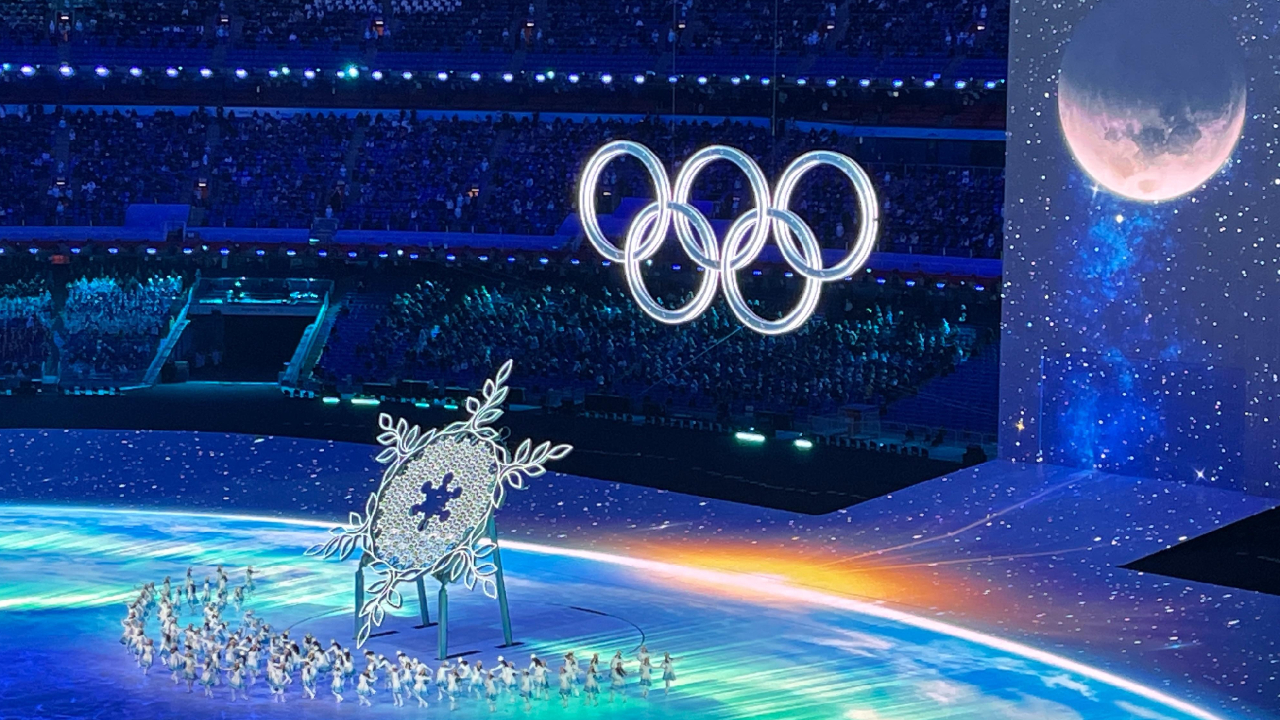
The opening ceremony of the 2022 Beijing Winter Olympics at Bird's Nest.
SISU News Center, Office of Communications and Public Affairs
Tel : +86 (21) 3537 2378
Email : news@shisu.edu.cn
Address :550 Dalian Road (W), Shanghai 200083, China
06 February 2022 | By HU Chunchun, Shanghai Academy of Global Governance and Area Studies | Shanghai International Studies University
2022 Winter Olympics
The opening ceremony of the 2022 Beijing Winter Olympics at Bird's Nest.
|
O |
n 4 February, what was probably the smallest and most humble flame in Olympic history was lit at the Chinese National Stadium "Bird's Nest", and with it, athletes at the 2022 Winter Olympics got serious: now it is all about sporting performance and in it is reflected the human will for the better.
Although the Olympic spirit, including the promotion of peace, is now considered outdated in some postmodern countries, a moment like this, of all countries cheering for fair competition and the pure joy of self-overcoming, would be a rare treasure for the world and all of humanity.
Star director and two-time Olympic Opening Ceremony director Zhang Yimou has staged a performance that is in keeping with the zeitgeist of both the world and China. The comparison with the opening ceremony from the 2008 Summer Olympics is obvious: in 2008, for example, it was an armada of 2008 drummers shouting out the counting down from 10 to 1; in 2022, it was a digital display of the 24 Chinese solar terms that ushered in the opening of the Games which fell at the same day with the term “Arrival of Spring”.
What prompted the same director to create this performance, which is equivalent in an artistic sense and fundamentally different in terms of conception and perception? In an interview following the opening ceremony, Zhang Yimou summarised the differences between 2008 and 2022 in such a way that further interpretation has become superfluous. Zhang said that 14 years ago he - and thus China - wanted to tell the world who "we" are and what we have.
Today, he is driven by the fact that we belong to this world like everyone else and share much in common. The once curious newcomer to the modern and big world has now become a confident adult who invites the world to share in the beauty of his experience. This is the message of China in 2022.
Despite the joy of hosting a major event, hosting the Winter Olympics is no easy task for China. After all, winter sports are a largely unknown phenomenon in most of China except for the northeast region and Xinjiang. A small example of this is that 10 years ago there were only 300 registered youth ice hockey players in China. One can hardly expect top performance in professional sports from such a thin grassroots base. For this reason, hosting the Winter Olympics provides an important boost in raising awareness of winter sports among the public and the general population.
In other words, China does not take winter sports for granted as something that Chinese people do solidly. One sees the potential and wants to promote it according to the logic of development, just as China has developed in the last decades. One has no pseudo-moral inhibitions about talking about the economic basis of sport. On the contrary, one knows from one's own experience that the combination of careful and visionary plans and market-based mechanisms could rather lead to as many actors as possible participating in winter sports and also benefiting from it. If one does not see this development logic, one probably has little understanding for the fact that new facilities and new infrastructures have been created in newly developed areas.
Indeed, one senses an enthusiasm among the population for winter sports. In Shanghai, for example. In this megacity, which lies on the same latitude as Cairo and hardly knows any snow, more and more indoor skiing and ice-skating facilities have opened up in recent years. Especially young Chinese, who have never dared to go on snow or ice before, are making their first experience. Perhaps a new fashionable activity is developing among the younger generations.
It is precisely this practical approach to sports promotion that marks China's transformation. People are associating sport more and more with something they enjoy. Accordingly, people are no longer obsessed with their nation's placing in the medal game, but cheer on the athletes for their commitment, as was seen after the defeat of the Chinese women's ice hockey team.
Freely according to the motto: Winning is fun, so is being there. In this sense: I am looking forward to the top performances of the athletes from all over the world and to their perfect or less perfect performance - with my compatriots. Maybe I'll also rent a pair of fancy plain skates in Shanghai and refresh my memories of winter sports, which I collected on real ice surfaces as a student in Beijing. I can beat some novices for sure. Who knows.
The author, Prof. HU Chunchun, is Director of the master programme in European Studies at Shanghai Academy of Global Governance and Area Studies, Shanghai International Studies University.
SISU News Center, Office of Communications and Public Affairs
Tel : +86 (21) 3537 2378
Email : news@shisu.edu.cn
Address :550 Dalian Road (W), Shanghai 200083, China

HONGKOU CAMPUS
550 Dalian Road (W), Shanghai 200083, China
SONGJIANG CAMPUS
1550 Wenxiang Road, Shanghai 201620, China
© Shanghai International Studies University | SISU | 上海外国语大学